
“Waka Ŋurrkanhayŋu - Regenerating the existence of life”
Worldwide and in Australia, reducing disaster risks and adapting to climate change is an urgent health priority (UNISDR, 2015, National Climate Change Resilience and Adaptation Strategy 2021-2025, 2021). In the tropical North of Australia substantial, diverse extreme ‘natural’ events and processes linked to climate change (bushfires, cyclones, flooding, sea level rise, smoke, extreme heat, humidity) seriously threaten human health and life, and bear enormous environmental, social and economic costs (Buergelt et al., 2021). Yet, the North’s capabilities and capacities to reduce, respond to and recover from these complex risks are declining. The disaster and climate change health risks are exacerbated for Indigenous peoples living in remote and very remote Indigenous communities due to historical and contemporary colonisation (Ali et al., 2021a,b; Buergelt et al., 2022; Dudgeon, Milroy & Walker, 2014; National Climate Change Risk Assessment First Pass Assessment Report, 2024; National Climate Change Adaptation Research Plan Indigenous Communities, 2012).
Parallel, Indigenous worldviews, knowledges and practices are increasingly recognised as the key to reducing the risk of disasters (Buergelt et al., 2017a; Buergelt & Paton, 2022a,b; Pascoe, 2014; Paton, 2022; Yunkaporta, 2019). This recognition led to the United Nations Office for Disaster Risk Reduction’s (UNDRR, 2015) Sendai Framework for Disaster Risk Reduction 2015-2030 calling for holistic Indigenous disaster risk reduction (DRR) research that is reviving and strengthening Indigenous knowledges and adaptive capabilities and capacities using community-based approaches. Holistic DRR theories that suggest that the interaction of psychological (e.g., beliefs, values, actions) and contextual (e.g., natural and built environment, cultural, social, cultural, spiritual, economic, technological, political) aspects and processes over time undermine or facilitate the development of adaptive capabilities and capacities that reduce the risk of disasters (Buergelt & Paton, 2014; Buergelt et al., 2017a; Paton, 2022). However, there is limited knowledge how to conduct holistic community-based disaster risk reduction research with Indigenous communities to understand what individual and contextual aspects and process strengthen and weaken Indigenous peoples, and how Indigenous knowledges and adaptive capabilities and capacities can be revived and strengthened. Our team and project has the capabilities and capacity to contribute to a substantial breakthrough in this area by generating novel knowledges that address these critical knowledge gaps and creating a place-based exemplar and roadmaps for creating the required paradigm shifts to scale the exemplar.
Our strategic preventative, long-term Waka Ŋurrkanhaynŋu initiative has been requested by, and is co-led and co-designed by TOs, Clan Leaders and CEOs of diverse Yolŋu clans living in the very remote Indigenous Galiwin’ku on Elcho Island (NT) in response to the devastating impacts of two category 4 cyclones in 2016. Since 2020, we – a team of local Indigenous Yolŋu researchers consisting of Ŋgorrudawalŋu (clan leaders) and Djuŋgayas (CEOs), and Western researchers – have been working together two-way to revive and strengthen Yolŋu living according to their ancient Law (Yolŋu ROM) to heal and prevent ‘natural’ and social disasters, and holistically restore harmony, equality, health and wellbeing.
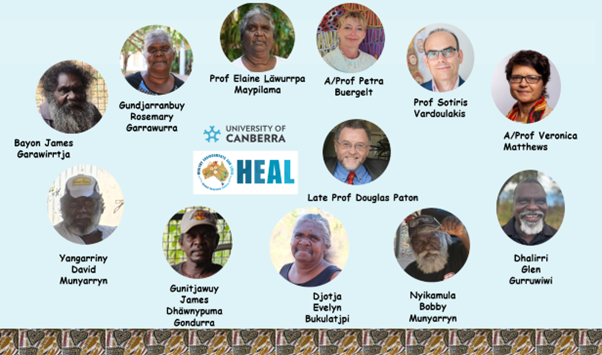
In phase 1 and 2 (2020-23), we holistically and in-depth co-created knowledges of what weakens Yolŋu and what strengthens Yolŋu in our AIATSIS funded project. That is, we identified the root causes that systematically create health inequities and ill-health, the systemic drivers of health, and how they interact. The identified networks enabled identifying the most salient and effective pathways that sustainably restore health by holistically and simultaneously (re)building Yolŋu capabilities and capacities. In the current phase 3, we will employ Indigenist Participatory Action Research to establish multidisciplinary and multisectoral collaborations that are co-investing, co-refining, co-implementing and co-evaluating the interconnected adaptive capability and capacity building pathways using Yolŋu and useful Western ways of being-knowing-doing.
Eight interconnected tangible key adaptive capability and capacity building pathways emerged:
- creating a Yolŋu Village Authority/Council made up of clan leaders and CEOs from all 16 clans using Yolŋu governance and kinship systems,
- repatriating belongings (artifacts, video and sound recordings, stories, photos),
- building an ecological local Yolŋu knowledge and language centre on country appropriate for all 16 clans and the tropical climate,
- creating an independent school that prioritises Yolŋu education on clan countries by clan knowledge holders using Yolŋu curriculums and pedagogies,
- living back on country on clan homelands and caring for country according to the Yolŋu ROM,
- developing and conducting two-way exchanges with Indigenous and non-Indigenous peoples on country,
- creating independent Yolŋu income streams (royalties, carbon credits, social enterprises),
- filming and sharing documentaries of pathways.


