Alumni Stories
Sue Heart embodies 'Education for Life'
For Sue Heart, education isn't just a profession – it's a passion that has driven her to want to change the system for the better.
With 30 years of teaching experience across four states, Sue has taught every year level in both government and non-government schools.
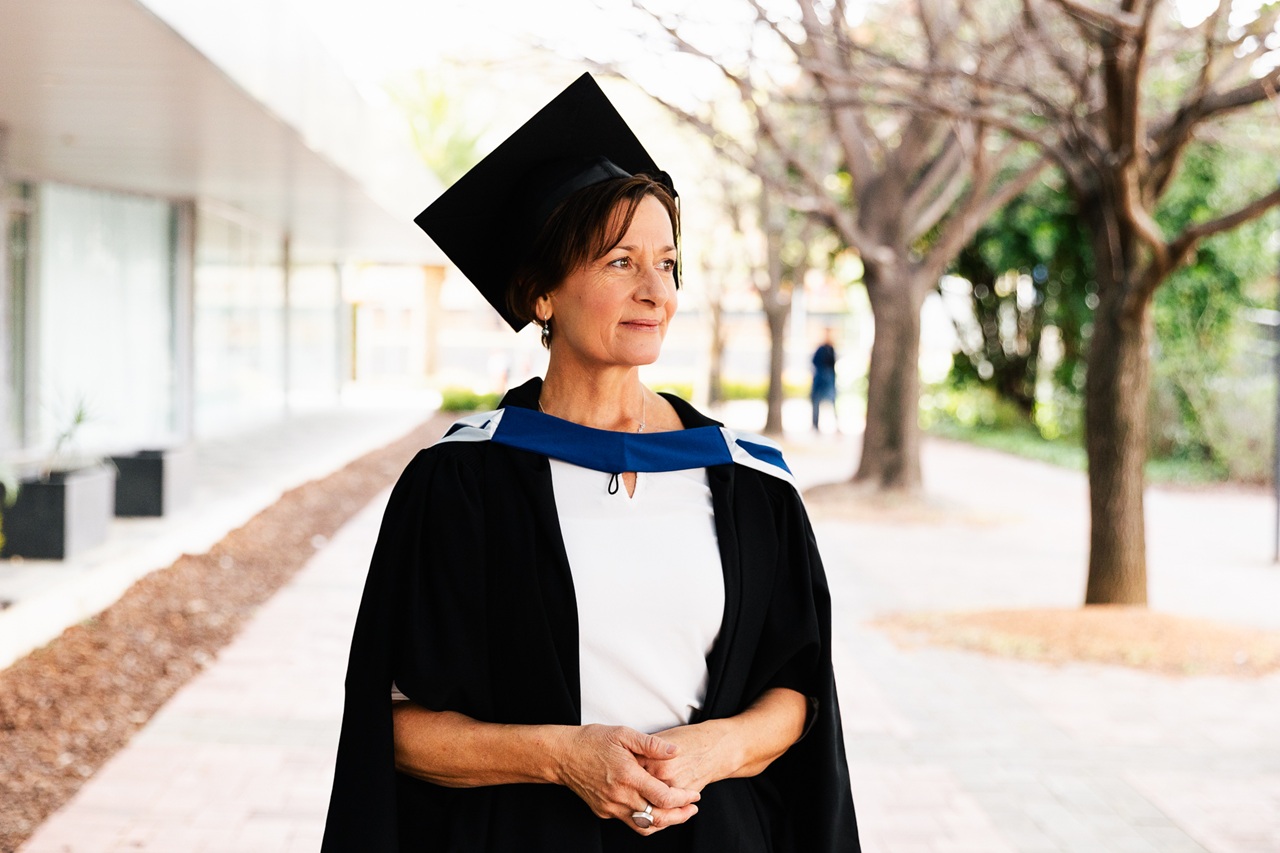
In September, she celebrated a personal education milestone of her own, graduating with a Master of Public Policy from the University of Canberra (UC).
It was her wealth of experience as a teacher that sparked her interest in postgraduate study – with the view to fulfill a long-held ambition to transform primary and secondary education in Australia.
“I have a breadth of experience where I could see that a lot of young people were struggling at school and despite trying all the teaching strategies I knew to engage them, I realised something else was going on,” Sue says.
Her realisation that many students were suffering from trauma led to her co-founding Trauma Awareness Network Australia (TANA) in 2018. The non-profit organisation was formed by Sue and two close friends in Tasmania, who all recognised that there is simple scientific way to understand and explain how trauma was a significant barrier to students' engagement and overall well-being.
“A lot of kids in our classrooms struggled to engage in their learning programs. I notice when they simply cannot focus their attention, sometimes not even on a 1:1 step-by-step explanation,” Sue says.
TANA’s efforts culminated in a Tasmanian community forum sponsored by a Member of Parliament, which brought together 200 people to discuss the issue and call for local data on child maltreatment.
In April 2023, Professor Ben Matthews’ team released a report on their research, funded by the federal government, revealing that 62 per cent of Australia's population had experienced at least one form of child maltreatment, underscoring the need for trauma-informed policies in education.
Sue's commitment to education and policy is driven by her desire to ensure that every child has the foundation they need to feel like a purpose-driven adult once they enter the world beyond school. She believes that schools can be hubs of positive experiences, even for children who face challenges at home. Her vision is for young people to complete their school years knowing their strengths and purpose, and having developed the skills to feel equipped to contribute to society, as “This is ultimately what brings happiness and contentment to a life.”
“I remember saying to a colleague about 15 years ago, the number of people who need help are going to outnumber the people who can help, if we don't do something,” Sue says.
“We need to do everything we can so that every child is given the skills to express themselves effectively in addition to the foundations of literacy and numeracy. All these things support building confidence.
“This is where I think our general education policy can go, to be designed for fulfillment of purpose. I want to say that by the end of their secondary education young people should know what their strengths are, and that they've been supported through their schooling experience, uncoveringing their purpose and building an idea of how they can best contribute to society.”
This way of thinking began for Sue back in the late 90s, when she began a master’s in education, with two young children in tow. Although she didn’t complete the course, she wrote a paper titled Education for the Fulfillment of Potential, which has since evolved into Education for the Fulfillment of Purpose, that sustained her interest in furthering her own education.
Fast forward to August 2022, Australia’s Education Ministers met to address the national teacher shortage crisis, highlighting the need for teachers from different jurisdictions to collaborate more effectively.
During that time, Sue had come across UC’s Master of Public Policy on her social media feed and applied for the course. She had moved to the Canberra region and worked as a casual teacher in government schools to sustain herself during her studies.
“I loved how it was a nested degree. I did four units, and I had a Graduate Certificate ... I did eight units, then I had my Graduate Diploma. I could leave it there if I wanted to,” she says.
“I liked the way the course was taught. It was intense – and challenging, as it wasn’t my background – but it gradually became easier and I realised I was shifting my identity, I was able to start seeing myself as a policy practitioner as well as an educator.”
Sue completed 12 units, walking across the stage in September to receive a Master of Public Policy.
“It's been 30 years since my last university graduation,” she says.
“There was a little moment when I was getting ready in the cap and gown and I thought, ‘I’m so glad I’m here’.”
Sue’s connection to UC didn’t stop there. She was a successful applicant for the 2024 Pathways to Politics for Women, a national program delivered by a network of universities.
“I learned about Pathways to Politics last year and I got what I call my ‘yes’ feeling,” Sue says.
“I was looking at the resources on website and was listening to Julia Gillard's famous speech in the House of Representatives, but I didn’t end up applying the first time around, as I was going to be in Europe.”
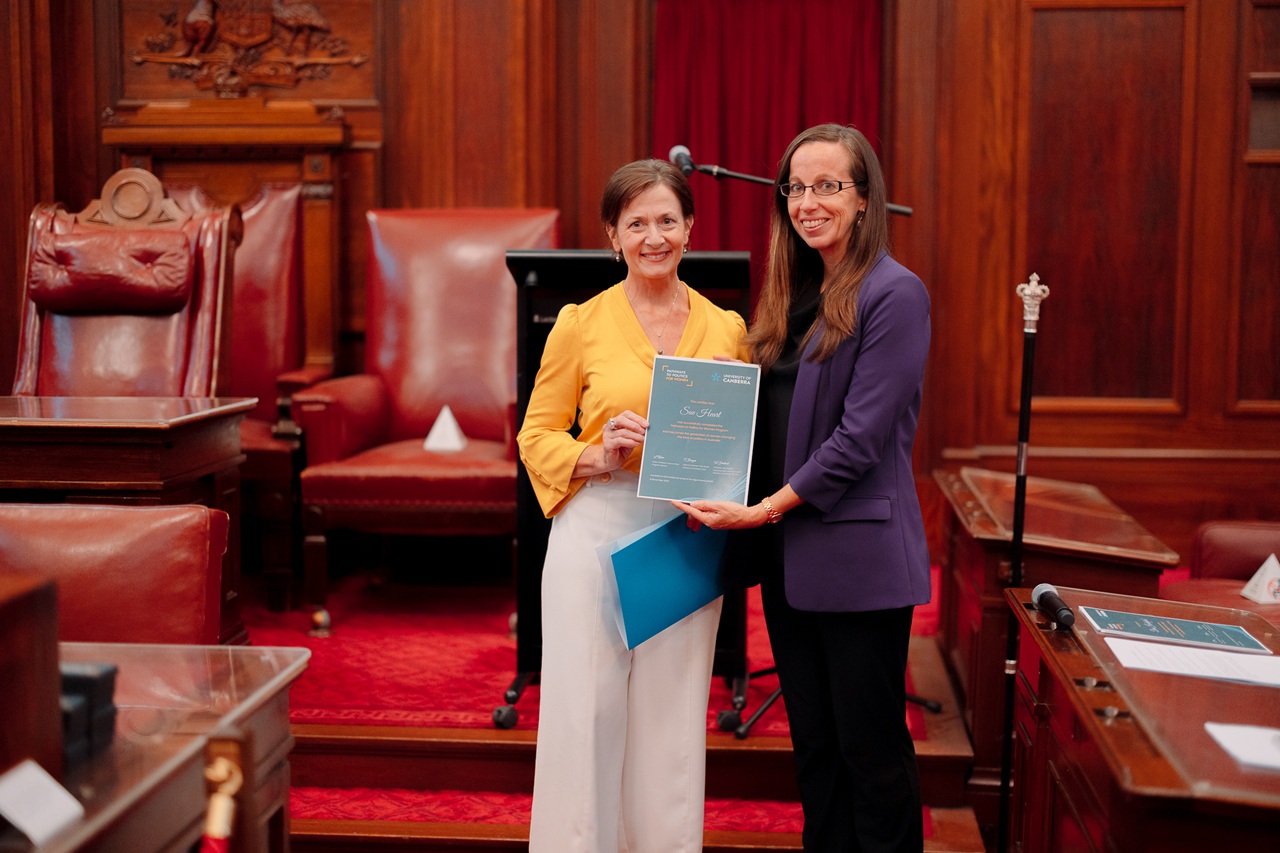
Sue was in UC’s second Pathways to Politics cohort and attended her graduation at Old Parliament House in November 2024. There, she delivered her campaign-style speech that marked the end of an experience she describes as “an incredible honour”. Sue and her peers are now part of a national alumni network that provides ongoing career support and mentorship.
“I loved the Pathways to Politics experience, especially going through it all with an amazing group of women,” she says.
“There was an incredible diversity of backgrounds and cultures, with a unifying force of wanting to do something to make a positive difference.
“It was an environment where we would support and uplift each other, rather than there being any competition, which was wonderful.”
While she may not aspire to run for office, Sue now feels like she is armed with the knowledge and insights to one day pursue a career as a political advisor.
For now, she is dedicated to carving out a career in policy, stemming from her belief that systemic change is possible.
Sue's story is a testament to the power of education and the impact of dedicated individuals who strive to create a better future for all.
“I’m a passionate educator and I’m passionate about learning, it’s my number one way through life and I want that for everyone,” she says.
“I say to kids: If you love learning and you have the skills to learn, you can do anything.”
“We need to do everything we can so that every child is given the skills to express themselves in addition to the foundations of literacy and numeracy. All these things support building confidence.
“This is where I think our general education policy can go, to be designed for fulfillment of purpose. I want to say that by the end of their secondary education young people should know what their strengths are, and that they've been supported through their schooling experience of with a sense of knowing their purpose and how they can best contribute to society.”
Words by Emma Larouche, photos by Liam Budge and supplied.